
AI Content Tool Pricing: Cost per 10 Articles and 100 Marketing Assets
Independent pricing guide. Last updated . How we evaluate →
Part of our AI Content guide
AI content tool pricing is usually the smallest line in a content budget: in the hypothetical scenarios below, a $20 to $79 writing plan sits beside about $1,250 of editing time for 10 articles. This guide prices three standard workloads across five writing tools and keeps the tool invoice separate from the human cost.

TL;DR: what should you budget?
Budget for editing time first, because it is over 90% of the total in most hypothetical scenarios below. Then pick the cheapest plan that fits your team shape.
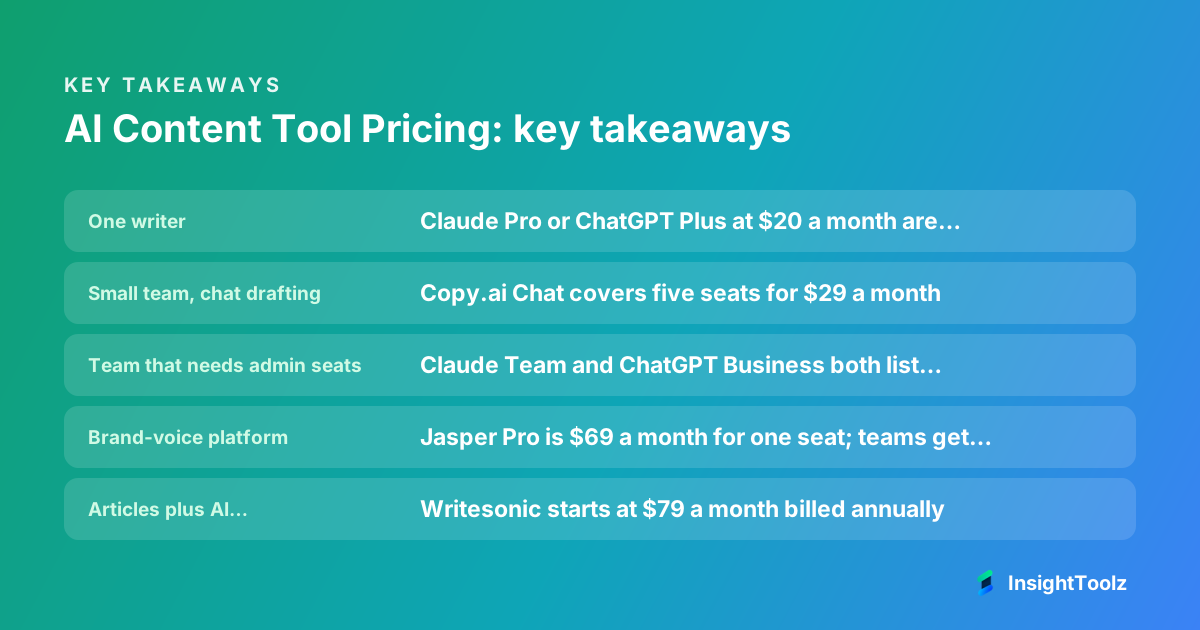
- One writer: Claude Pro or ChatGPT Plus at $20 a month are the cheapest published paid options here.
- Small team, chat drafting: Copy.ai Chat covers five seats for $29 a month.
- Team that needs admin seats: Claude Team and ChatGPT Business both list standard seats at $25 monthly or $20 annually.
- Brand-voice platform: Jasper Pro is $69 a month for one seat; teams get a quote.
- Articles plus AI search tracking: Writesonic starts at $79 a month billed annually.
How are AI content tools priced?
Most charge per person, then meter usage through fair-use limits, credits or media minutes. So two tools with the same headline price can cost very different amounts for your workload.
- Per user with usage limits. Claude and ChatGPT charge per person and cap usage over time windows, not by word.
- Per seat with feature tiers. Jasper keeps SSO and API access for its quoted Business tier.
- Flat plans plus allowances. Copy.ai bundles five seats into Chat and meters automation in workflow credits; Writesonic caps articles per month.
- Media meters. Video and design tools add minutes, exports or AI credits.
What do the main AI writing plans cost?
Entry paid plans run from $8 to $79 a month on the official pages we checked, and team pricing ranges from published per-seat rates to sales quotes. Each block covers prices, billing, free plan or trial, who it suits and who should skip it.
Claude: published prices from free to Enterprise
Claude's pricing page lists Free at $0, Pro at $20 billed monthly or $17 a month annually ($200 up front), Max at $100 and Ultra at $200 a month (checked 8 November 2026).
Team covers 2 to 150 seats: standard seats are $25 monthly or $20 annually, premium seats $125 or $100. Enterprise is US$20 per seat billed annually, 20-seat minimum, plus usage at API rates (checked 8 November 2026).
- Best for: writers and teams who want every tier priced in public.
- Skip it if: you need image generation in the same seat; the plan comparison lists no image generator.
ChatGPT: low entry price, published Business seats
OpenAI's pricing documentation lists Go at $8, Plus at $20 and Pro tiers at $100, $200 or $500 a month (checked 8 November 2026). ChatGPT's pricing page lists a free plan, monthly billing for Go and Plus, and Enterprise through sales (checked 8 November 2026).
Business standard seats are $20 a user a month billed annually or $25 billed monthly, for 2 or more users (checked 8 November 2026). OpenAI's sources have conflicted on the annual rate before; the live page now states $20.
- Best for: teams that want writing and image creation, listed from the free plan up, in one subscription (checked 8 November 2026).
- Skip it if: you need annual billing on an individual plan; the pricing page lists annual terms only for Business and Enterprise.
Jasper: single-seat Pro, quoted Business
Jasper's pricing page lists Pro at $69 a seat a month billed monthly or $59 billed yearly, one seat, and a 7-day free trial (checked 8 November 2026). Business is custom-priced, starts with a 12-month commitment and adds SSO and API access.
- Best for: marketing teams that will pay for brand controls and a managed contract.
- Skip it if: you are a team of two to five wanting a published team price; more than one Pro user means contacting sales.
Copy.ai: one flat price for five chat seats
Copy.ai's pricing page lists Chat at $29 a month billed monthly or $24 a month billed annually ($288 a year), with five seats, unlimited chat words and OpenAI, Anthropic and Gemini models (checked 8 November 2026). Workflow plans start at Growth, $1,000 a month for 75 seats and 20,000 workflow credits.
- Best for: small teams that mainly need shared chat drafting at the lowest per-seat cost here.
- Skip it if: you want workflow automation on a small budget, or a free plan; the pricing page describes none.
Writesonic: annual prices with article caps
Writesonic's pricing page lists Starter at $79 (1 user, 15 articles a month), Basic at $199 (2 users, 25 articles) and Growth at $399 (3 users, 50 articles), each a month billed annually (checked 8 November 2026).
Extra users cost $50 a month on Basic and Growth, up to five in total. The page offers a free trial with no credit card but does not state its length.
- Best for: teams that want article generation alongside AI search visibility tracking.
- Skip it if: you only need a writer, or you want monthly billing; the page shows annual rates only.
Why isn't cost per word a fair comparison?
Because the words you pay for aren't the words you publish. A tool that produces 3,000 words you rewrite costs more in total than one that produces 1,200 words you lightly edit, even at a lower per-word rate.
What workloads and assumptions do the scenarios use?
An article is a researched 1,500 to 2,000-word post with sources, and an asset is a short piece such as a social post, ad variant or email. All scenarios are hypothetical and assume a blended editing cost of $50 an hour, which you should replace with your own rate.
Editing estimates are 2.5 hours per article, 10 minutes per short asset, 1 hour per short video and 5 minutes per image. These are editorial assumptions, not measurements.
What do the three workloads cost?
On these hypothetical assumptions, editing costs about $1,250 for 10 articles, $833 for 100 assets and $2,650 for a mixed five-person month. The writing invoice ranges from $20 to $499 where prices are published.
| Workload | Editing time | Claude | ChatGPT | Jasper | Copy.ai | Writesonic |
|---|---|---|---|---|---|---|
| A: 10 articles, one writer | 25 h / $1,250 | $20 (Pro) | $20 (Plus) | $69 (Pro) | $29 (Chat) | $79 (Starter, billed annually) |
| B: 100 assets, three people | 16.7 h / $833 | $75 (three Team standard seats) | $75 (three Business standard seats) | Custom quote (Business) | $29 (Chat, five seats) | $399 (Growth, three users, billed annually) |
| C: 10 articles, 100 assets, 8 videos, 40 images, five people | 53 h / $2,650 | $125 (five Team standard seats) | $125 (five Business standard seats) | Custom quote (Business) | $29 (Chat, five seats) | $499 (Growth plus two $50 users, billed annually) |
Workload A: one writer, 10 articles
Hypothetical totals run from $1,270 (Claude Pro or ChatGPT Plus) through $1,279 (Copy.ai) and $1,319 (Jasper) to $1,329 (Writesonic Starter), or $127 to $133 per article. Cutting editing from 2.5 to 2 hours saves $250 a month, more than four times the widest plan gap.
Our guide to long-form AI blog writing tools compares the research and sourcing features that move that number.
Workload B: three people, 100 assets
Copy.ai's flat Chat plan gives the lowest published total, about $862, against about $908 for three Claude or ChatGPT seats and about $1,232 for Writesonic Growth. Jasper needs a quote.
The AI copywriting software roundup compares which templates shorten review, and the Jasper, Copy.ai and Writesonic comparison covers how those platforms differ.
Workload C: five people, mixed output
Hypothetical totals are about $2,679 on Copy.ai, $2,775 on Claude or ChatGPT and $3,149 on Writesonic, before media tools. Annual billing cuts five Claude Team or ChatGPT Business standard seats from $125 to $100.
Media tools meter separately: Descript sells top-ups only on Creator and Business plans (checked 8 November 2026). Check Canva's pricing page and Descript's pricing page, plus our guides to AI video editing tools and AI image generators for ad creative.
Does the subscription matter next to editing time?
Barely, on these assumptions, but the editing estimate is the input most likely to be wrong. If your real editing time per article is double ours, the tool matters more, because a better draft is the only lever on the larger cost.
So judge tools on draft quality for your own briefs during a trial, not on the price gap between plans.
Should you pay monthly or annually?
Pay monthly until you know which roles use the tool every day, then move only those seats to annual. Listed annual discounts are 20% on Claude Team and ChatGPT Business standard seats, about 17% on Claude Pro and Copy.ai Chat, and $59 instead of $69 on Jasper Pro.
- ChatGPT lists no annual option for Go or Plus.
- Jasper Business starts with a 12-month commitment.
- Writesonic shows annual rates only.
- Ask whether annual seats can be reassigned when people leave, because an idle seat erases the discount.
What pushes you into the next tier?
Usage limits, a second user and security requirements, in roughly that order. Each has a cheaper response than upgrading everyone.
- One person hits limits weekly: upgrade that person only, for example to a Claude Team premium seat or a higher ChatGPT tier.
- A second writer joins: Claude and ChatGPT publish team seats, Copy.ai Chat already includes five, and Jasper moves you to a quote.
- Clients need SSO or audit logs: Claude lists SSO from Team and audit logs on Enterprise; Jasper lists SSO on Business. ChatGPT's pricing page does not break these out, so ask OpenAI sales.
At renewal, audit real logins. Our marketing stack audit guide shows how to find unused seats and overlapping tools.
What isn't public, and what should you ask sales?
Jasper Business, ChatGPT Enterprise and Writesonic Enterprise are quoted, and Claude Enterprise adds usage at API rates to its seat price. Renewal discounts are rarely public, so get them in writing.
- How are usage limits or credits defined, and what happens when we hit them mid-month?
- Which brand, collaboration and security features sit on which tier?
- Can annual seats be reassigned or reduced at renewal?
- Is our content used for model training, and can that be switched off on our plan?
What else do buyers ask about AI content costs?
The recurring questions are about fair per-article costs, platforms versus assistants, and free plans. Here are short answers.
What is a fair cost per AI-assisted article?
There is no universal figure. In hypothetical Workload A it is about $127 to $133 including editing, almost all of it human time, so your own editing hours and internal rate decide the answer.
Is a general assistant cheaper than a marketing platform?
On the invoice, usually yes for one writer, though Copy.ai's five-seat Chat plan undercuts per-seat assistants for small teams. Overall, it depends on whether a platform's brand and workflow features save enough editing time to cover the difference.
Are free plans enough for a content team?
For trying prompts, yes; for deadline work, rarely. Claude and ChatGPT both list free plans with tighter limits, Jasper offers a 7-day trial, Writesonic offers a free trial with no card, and Copy.ai's pricing page describes no free plan.
How often should you re-check these numbers?
Every 60 to 90 days, re-dating every figure, because plan names and limits in this category change often. ChatGPT's Business rates, Writesonic's allowances and Jasper's team terms are the figures to re-confirm first.
For the tools themselves, start with our AI writing tools for marketing teams, weigh the two big assistants in ChatGPT vs Claude for marketing workflows, check what free AI writing plans allow, and budget search data separately with the SEO software pricing guide. The AI content software category hub lists every related buying guide.
Keep reading
All AI Content guides → Best of
Best AI Marketing Tools for a Small Agency Stack
The AI marketing tools a small agency needs, built as lean, balanced and advanced stacks across research, content, design, email, CRM and reporting.
Read guide → Buying guide
Best AI Writing Tools for Marketing Teams
The best AI writing tools for marketing teams, split by job: long-form, short copy, brand governance, SEO and collaboration, with limits and…
Read guide → Comparison
ChatGPT vs Claude for Marketing Workflows
ChatGPT vs Claude for marketing, compared by job: research, drafting, data, images, files, collaboration, plan costs and data policies, with dated…
Read comparison →