Best AI Content Brief Tools for SEO Teams
Independent buying guide. Last updated . How we evaluate →
Part of our AI Content guide
AI content brief tools fall into three groups: SERP-driven builders such as Frase and Clearscope, research assistants such as Perplexity, ChatGPT and Claude, and content optimization suites such as MarketMuse, Surfer and Semrush. Most teams need one search tool plus one research assistant.
What's the TL;DR on AI content brief tools?
Pair one search tool with one research assistant, and keep an editor in charge of intent and sources. No tool here checks facts for you.
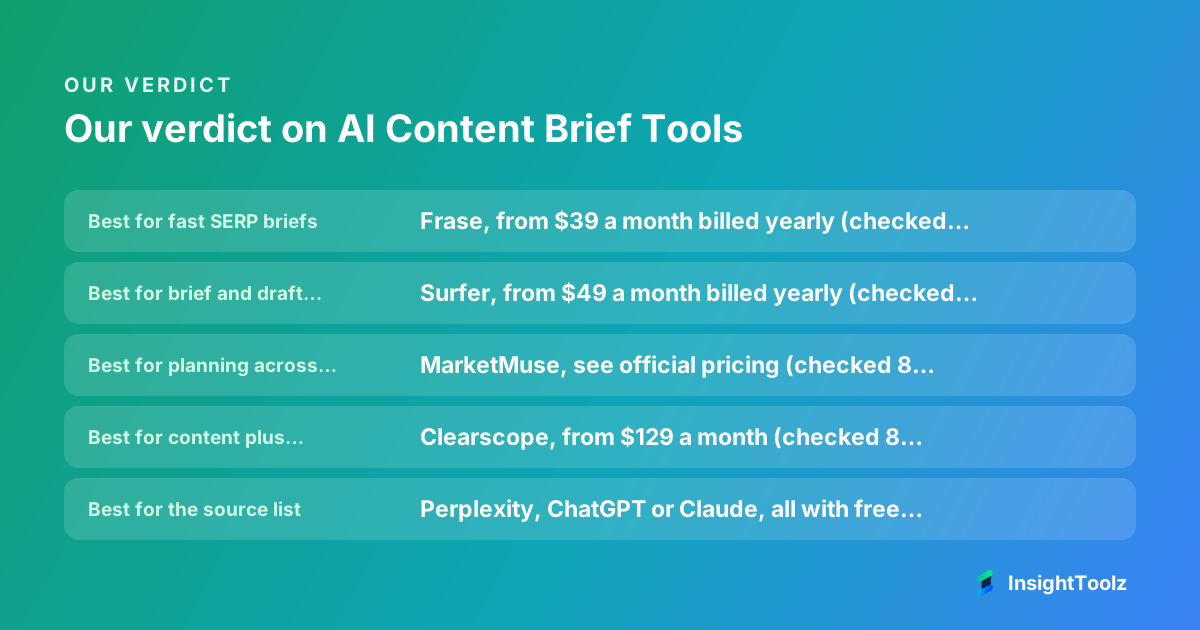
- Best for fast SERP briefs: Frase, from $39 a month billed yearly (checked 8 November 2026).
- Best for brief and draft in one editor: Surfer, from $49 a month billed yearly (checked 8 November 2026).
- Best for planning across a big site: MarketMuse, see official pricing (checked 8 November 2026).
- Best for content plus AI visibility tracking: Clearscope, from $129 a month (checked 8 November 2026).
- Best for the source list: Perplexity, ChatGPT or Claude, all with free plans (checked 8 November 2026).
What is an AI content brief tool?
An AI content brief tool builds the plan a writer follows before drafting: search intent, outline, entities, questions and sources for a target keyword. It does this by analyzing ranking pages, summarizing research or scoring coverage across a site.
- Enter a keyword: the tool pulls the pages that rank for it.
- Analyze the SERP: it extracts headings, terms and questions those pages cover.
- Propose an outline: you cut what only exists because competitors have it.
- Gather sources: a research assistant finds candidates an editor then checks.
- Hand off: the brief goes to a writer with audience, angle and no-go claims.
This page sits within the AI content software category.
How do the AI content brief tools compare?
The table groups each tool by type, with its lowest listed paid price and one material limit. Prices are in US dollars as shown on official pages on 8 November 2026.
| Tool | Type | Best for | Entry paid price | One material limit | Official link |
|---|---|---|---|---|---|
| Frase | SERP-driven brief tool | Keyword to outline, fast | Starter $39/month annual, $49 monthly | Starter allows 10 articles | frase.io |
| Clearscope | SERP-driven brief tool | Content plus AI visibility tracking | Essentials $129/month | 20 drafts a month on Essentials | clearscope.io |
| MarketMuse | Content optimization suite | Inventory-level planning | Not listed; book a demo | Optimize plan: 5 briefs a month | marketmuse.com |
| Surfer | Content optimization suite | Brief and draft in one editor | Discovery $49/month billed yearly | Docs and WordPress extensions start on Standard | surfer.ai |
| Semrush | SEO suite | Existing Semrush users | SEO $139/month, $117.33 annual | Content optimization listed on Pro+ only | semrush.com |
| Perplexity | Research assistant | Cited source discovery | Pro price not shown; see official page | Cites weak sources too | perplexity.ai |
| ChatGPT | Research assistant | Turning inputs into a brief | Go $8/month; Plus $20/month | No keyword or SERP data | chatgpt.com |
| Claude | Research assistant | Turning inputs into a brief | Pro $17/month annual, $20 monthly | No keyword or SERP data | claude.com |
What makes a great AI content brief tool?
A great AI content brief tool gets a writer from keyword to a trustworthy plan quickly, without copying the consensus. Our picks are research-based, from official sites and pricing pages, not hands-on testing, so we don't rate brief quality.
- Intent handling: helps you pick one search intent when results are mixed.
- Outline structure: proposes headings you can cut and reorder.
- Entities and questions: lists the terms and questions a page must cover.
- Source support: surfaces citations an editor can verify.
- Site view: shows what you already cover, to avoid cannibalization.
- Collaboration and export: gets the brief into the writer's editor.
These picks follow the criteria, not payment.
Which SERP-driven tools and suites build the best briefs?
SERP tools analyze the pages that rank for a query, and suites add planning and scoring across a site. They cover the search side of the brief but not the evidence.
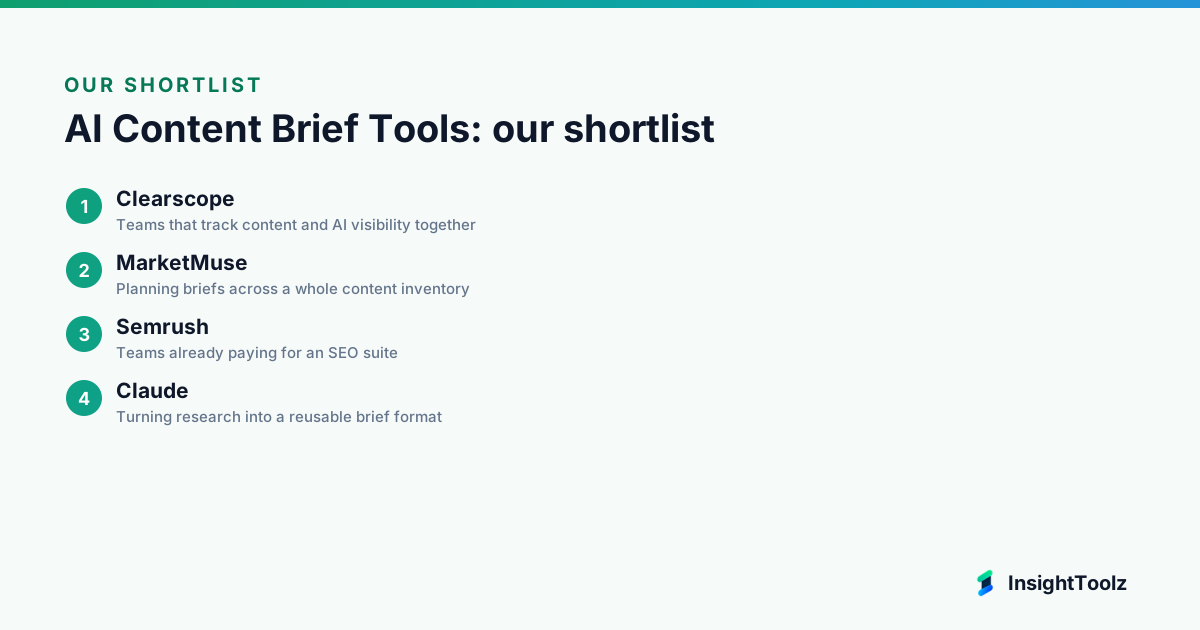
1. Frase: best SERP-driven brief builder for small teams
Frase is an SEO content tool that combines SERP research, outlining and drafting in one workspace.
What it does well: it offers a short path from keyword to usable outline. Publishing integrations let finished drafts go straight to common CMSs.
- SERP research to outline in one tool.
- WordPress, Webflow, Sanity and Wix publishing on all plans.
- Starter covers 1 seat, 1 site and 10 articles.
- 7-day trial with no card on every plan.
Pricing: Starter is $39 a month billed yearly ($468) or $49 monthly, with Professional at $103 and Scale at $239 on yearly billing (checked 8 November 2026). There is no free plan.
Best for: SEO writers and small agencies who want research, outline and draft in one tool.
Limitations: outlines built from competing pages tend to mirror them. Skip it if you need inventory-level planning across hundreds of pages.
2. Surfer: best when the brief and the draft live in one editor
Surfer is a content optimization platform that scores drafts against search guidelines as you write.
What it does well: the brief is enforced while the writer writes. Extensions bring guidance into Google Docs and WordPress on higher plans.
- AI SEO optimization guidelines on every plan.
- Content Score on every plan.
- AI writing assistant on every plan.
- Google Docs and WordPress extensions from Standard.
Pricing: on yearly billing, Discovery is $49 a month, Standard $99 and Pro $182 (checked 8 November 2026).
Best for: teams that want guidelines, scoring and drafting in a single workspace.
Limitations: writers can chase the score instead of the reader. Skip it if your writers won't work in its editor or extensions.
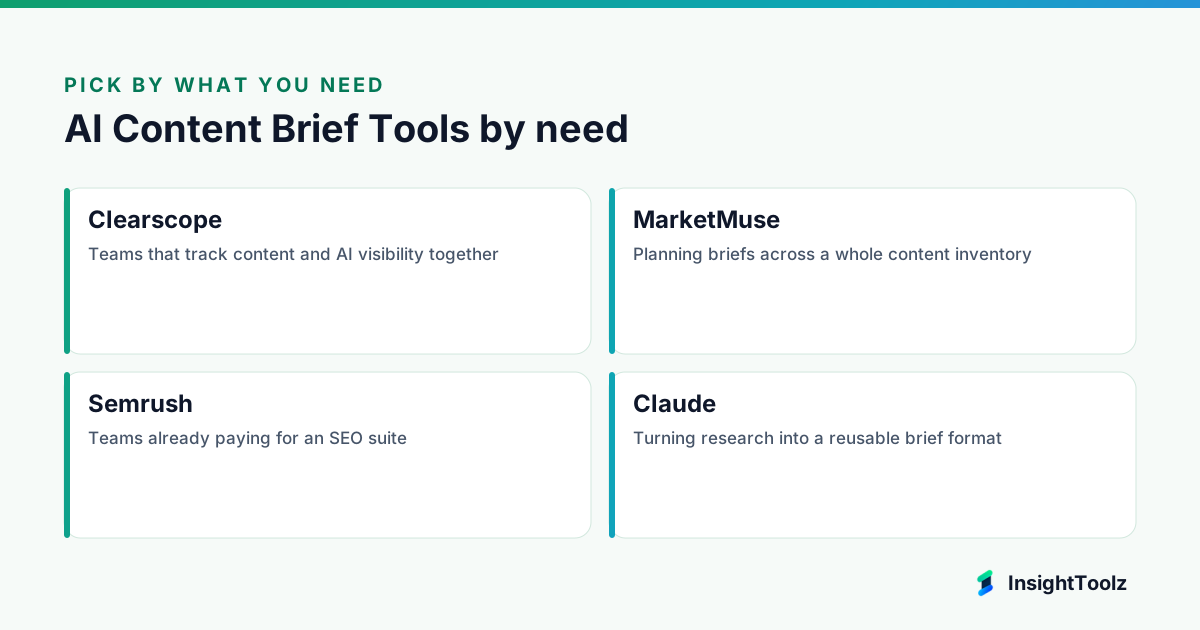
3. Clearscope: best for teams that track content and AI visibility together
Clearscope is a content optimization platform that pairs drafting guidance with query and visibility tracking.
What it does well: unlimited users and projects on every plan mean seats don't block freelancers. Tracking sits alongside briefs.
- Unlimited users and projects on every plan.
- Essentials covers 50 tracked queries and 50 pages.
- 20 drafts a month on Essentials; extras cost $50 each.
- 14-day free trial.
Pricing: Essentials is $129 a month and Business $399 a month, with Enterprise custom (checked 8 November 2026).
Best for: content teams with many writers.
Limitations: it has the highest entry price here, and it won't build a source list. Skip it if you only need a few briefs a month.
4. MarketMuse: best for planning briefs across a whole content inventory
MarketMuse is a content planning and optimization suite that models what your site already covers.
What it does well: paid plans include a site inventory, so briefs reflect existing coverage. That helps large sites decide which brief to write next.
- Free plan with 10 queries a month.
- Optimize includes 5 briefs a month, Research 10 and Strategy 20.
- All 9 brief types on Strategy only.
- Site inventory on paid plans.
Pricing: the pricing page shows no figures and routes paid plans to a demo, so see official pricing (checked 8 November 2026).
Best for: in-house teams with large sites.
Limitations: no public price makes budgeting slower. Skip it if you publish a handful of posts a month on a small site.
5. Semrush: best for teams already paying for an SEO suite
Semrush is an all-in-one SEO suite covering keyword research, competitor analysis and content tools.
What it does well: briefs sit next to keyword and competitor data you already use. That avoids buying a second tool for some teams.
- Free plan and a 7-day trial.
- Keyword and competitor data in the same suite.
- Content optimization listed on Pro+ only.
- Several plan tiers for growing teams.
Pricing: the SEO plan is $139 a month or $117.33 a month billed annually; Pro+ is $299 or $248.17 (checked 8 November 2026).
Best for: agencies whose keyword research already lives in Semrush.
Limitations: brief features are a small part of a large suite, so confirm your plan includes content optimization. Skip it if you don't otherwise need an SEO suite.
Which research assistants are best for the brief's source list?
Research assistants find and summarize sources, which fills the evidence gap SERP tools leave. None of them supply keyword volumes or term scoring.
6. Perplexity: best research assistant for the source list
Perplexity is an AI answer engine that returns responses with linked citations.
What it does well: citations make verification faster. Pro adds deeper research and more citations per answer.
- Free Standard plan, plus Pro and Max.
- Extended Research access on Pro.
- More citations per answer on Pro.
- More file uploads on Pro, per Perplexity's help center (checked 8 November 2026).
Pricing: the help center lists plans but no Pro price, so see official pricing on Perplexity Pro (checked 8 November 2026).
Best for: writers who want a fast first pass at sources with citations attached.
Limitations: it cites weak secondary sources too, so every link needs checking. Skip it if you want SERP structure or term guidance.
7. ChatGPT: best low-cost assistant for structuring briefs
ChatGPT is OpenAI's general AI assistant, sold on individual and business plans.
What it does well: it turns pasted SERP notes and sources into a structured brief. Projects can keep a brief template for reuse.
- Projects on Free, Go, Plus and Pro.
- Limited deep research on Free, per ChatGPT's pricing page (checked 8 November 2026).
- Business plan for 2 or more users.
- No keyword or SERP data.
Pricing: Free is $0, Go $8 a month, Plus $20 and Pro from $100; Business is $20 per user a month billed annually or $25 monthly (checked 8 November 2026).
Best for: editors who want a structured brief back from their notes.
Limitations: no keyword volumes or term scoring, so pair it with an SEO data source.
8. Claude: best for turning research into a reusable brief format
Claude is Anthropic's general AI assistant, sold on individual and team plans.
What it does well: it turns pasted SERP notes and sources into a structured brief. Projects can hold a brief template and style rules for reuse.
- Up to 5 Projects on Free.
- Web search on every plan.
- Research on paid plans, per Claude's pricing page (checked 8 November 2026).
- No keyword or SERP data.
Pricing: Free is $0, Pro $17 a month billed annually ($200 up front) or $20 monthly, and Max from $100 a month (checked 8 November 2026).
Best for: editors who want a structured brief back from their notes.
Limitations: no keyword volumes or term scoring, so pair it with an SEO data source.
Which AI content brief tool should you use?
Pick a SERP-driven builder for fast outlines, a suite if you plan across a large site, and a research assistant for the source list. Most teams need one of each kind.
- You want the fastest keyword-to-outline workflow: Frase.
- You want brief and draft enforced in one editor: Surfer.
- You track content and AI visibility together: Clearscope.
- You plan briefs across a large inventory: MarketMuse.
- You already live in an SEO suite: Semrush.
- You need cited sources: Perplexity.
- You want notes turned into one brief format: ChatGPT or Claude.
- You need scoring at the draft stage: see our guide to content optimization tools and the AI SEO tools comparison.
How does an AI-assisted content brief workflow work?
Move from query to intent, outline, entities, questions and a verified source list, with a human decision at each step. The tools speed up each step; they don't make the decisions.
- Query: confirm the primary keyword and its variants with your keyword research tool.
- Intent: read the top results yourself and write one sentence on what the searcher needs.
- Outline: let a SERP tool propose headings, then cut anything that only mirrors competitors.
- Entities and questions: use term suggestions as a checklist and map each question to a heading or the FAQ.
- Sources: collect candidates with a research assistant, then keep only primary sources an editor has opened.
- Hand-off: add audience, angle, word range, internal links and the claims the writer must not make.
An AI brief saves time on SERP research and outlining, but someone still has to strip copied structure and verify sources. None of the official pages we checked measures total editor time.
What QA and fact-check rules should editors apply to AI briefs?
Every brief should pass a short editor checklist before it reaches a writer: confirmed intent, original angle, verified sources and explicit no-go claims. These rules stop AI errors spreading into every draft.
- Intent check: does the outline answer the searcher's real question?
- Source rule: every statistic and product claim links to a primary source the editor has opened.
- No invented numbers: delete any figure a tool supplied without a source.
- Originality: at least one section the ranking pages don't cover.
- Cannibalization: confirm no existing page already targets the same intent.
For drafting from these briefs, see AI tools for long-form blog writing. The AI content quality evaluation guide covers QA at the draft stage.
What is the bottom line on AI content brief tools?
Pair one SERP or suite tool with one research assistant, and keep an editor in charge of intent and sources. Frase or Surfer suits most small teams, MarketMuse suits large sites, and Perplexity, ChatGPT or Claude handles the research side.
Next steps: build three briefs for real keywords in two tools during their trials and compare how much each needed fixing, run the editor QA checklist above on each, and see the AI writing tools pillar for what to draft with.
What else do content teams ask about AI brief tools?
These are the questions editors and SEO leads raise once briefs start coming from software. The answers assume a human signs off every brief.
Can an AI tool write the whole brief without an editor?
It can draft one, but an editor should still confirm intent, cut competitor-copied structure and verify every source. A brief that goes out unchecked passes its errors to every writer who uses it.
Do I need a SERP-driven tool if I already use a chatbot?
Usually yes for SEO work. General assistants don't supply keyword data or consistent SERP analysis, so pair one with a SERP tool or an SEO suite for the search side of the brief.
How many sources should a content brief include?
Enough to support every claim the writer is expected to make, ideally primary sources. A short list of verified primary sources beats a long list of unchecked secondary ones.
Should briefs target a content score?
Treat a score as a coverage check, not a goal. Writers who chase a number tend to pad copy with terms, which helps no reader.
Is there a free AI content brief tool?
MarketMuse and Semrush have free plans with tight limits, and Perplexity, ChatGPT and Claude have free tiers for research. Frase has a 7-day trial but no free plan.
Keep reading
All AI Content guides → Best of
Best AI Video Editing Tools for Marketing Teams
Compare AI video editing tools for marketing teams: captions, clipping, brand kits, export limits, seat versus credit pricing and commercial-use…
Read guide → Best of
Best AI Presentation Tools for Sales and Marketing Teams
AI presentation tools for sales and marketing teams compared on prompt-to-deck generation, brand templates, imports, export fidelity and presenter…
Read guide → Comparison
ChatGPT vs Claude for Marketing Workflows
ChatGPT vs Claude for marketing, compared by job: research, drafting, data, images, files, collaboration, plan costs and data policies, with dated…
Read comparison →